
Palm Harbor, FL · Garage Door Service
Garage Doors on Older Palm Harbor Homes Were Never Built to Hold Heat
Palm Harbor homes built 1958-2005 often have single-skin steel doors with no foam core. Here's what that means for comfort, repair, and replacement cost.
- Repairs & new doors
- Springs & openers
- Serving 4 nearby communities
The Problem
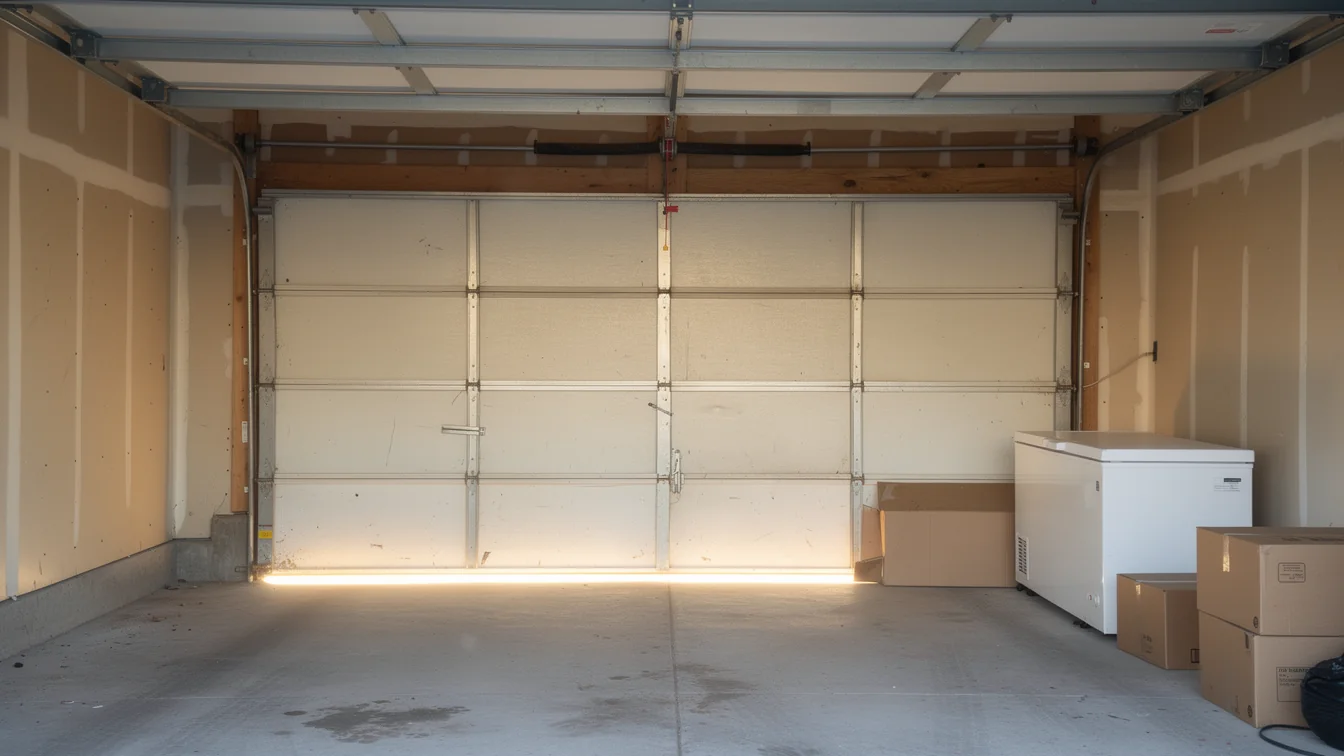
Most houses in this part of the county went up between 1958 and 2005, with the median build year landing around 1980, and the 31 named areas that make up this service territory are heaviest on 1980s and 90s stock. None of that construction had to meet an insulation standard for garage doors because none existed yet. What you get on a lot of these houses is a single layer of steel, maybe with a few cross-struts for stiffness, and nothing behind it. No foam core, no thermal break at the track, no weather seal worth mentioning beyond a strip of vinyl at the bottom.
That was fine when a garage was just a place to park and store the mower. It's a different story on houses where the garage shares a wall with a bedroom, laundry room, or converted den - common in this housing stock once families started finishing out that square footage in the 80s and 90s. The door becomes part of the building envelope whether it was designed for that job or not. If your door still has the original panel from when the house was built, you're looking at hardware and material choices made before anyone was thinking about R-value in a garage door.
Leaving It Alone
An old uninsulated door doesn't fail all at once. It sags a little at the bottom corners first, usually where the roller brackets have worked loose over the decades. Then the seal along the floor stops meeting the slab evenly, and you start losing the fight on temperature control in that room next to the garage. None of this is dramatic. It's slow enough that most owners don't notice until the door is hard to lift by hand, which usually means the torsion spring is losing tension - original springs on a 1958-2005 build have had thirty to sixty years of cycles on them, more than any spring is rated for.
We'll be straight with you: not every old door is worth saving. If the panel is original and the steel has started to oxidize through at the bottom, patching it is a short-term fix, not a repair. We'll tell you when that's the case instead of running up a bill on a door that's going to need replacing again in a year or two. A homeowner in this area with a 1980s build is more likely dealing with worn hardware on a serviceable panel than a panel that's actually failed - but we check both before we quote anything.
What You Pay
We don't post a flat number here because what a job costs depends on what's actually wrong - spring replacement, roller and track work, or a full panel swap are three different jobs with three different price tags, and we're not going to make one up to fill this paragraph. What we can tell you is what drives the decision on a house like yours. Median household income across this service area runs around $77,335, and most owners we talk to are weighing a repair against a replacement on a door that's anywhere from twenty to sixty-five years old depending on when their section of the neighborhood was built.
The honest math usually comes down to this: if the opener, springs, and tracks are original to a house built in the 1960s or early 70s, you're often better off putting money into a new insulated door than chasing parts for hardware that stopped being manufactured decades ago. On a house built closer to 1990 or 2000, a lot of the original hardware is still serviceable, and a repair makes more sense. We'll walk the door with you and tell you which category yours falls into before we talk numbers.
How Local Conditions Play In
This is a mild temperate climate, not a freeze-thaw one, so you're not dealing with ice splitting old seals the way a door up north would. But mild doesn't mean irrelevant. A garage door without a thermal break still lets heat transfer straight through the steel, and in a climate where the AC runs most months of the year, that uninsulated panel is working against your cooling bill every single day, not just during a cold snap like it would somewhere with real winters.
We work out of Palm Harbor and cover the surrounding area - Crystal Beach a mile to the WNW, Ozona two miles SW, out to East Lake, Oldsmar, and Safety Harbor in the 5-6 mile range, and further out toward Westchase, Trinity, and Keystone. Across that territory the pattern repeats: houses built from the late 1950s through the early 2000s, original doors still hanging on a lot of them, and the same gap in the build codes that left garage doors out of the insulation conversation entirely. If your door predates that conversation, replacing it with an insulated panel is one of the more direct ways to close that gap, rather than patching hardware that was never designed to hold heat in the first place.
Frequently asked questions
How do I know if my garage door has any insulation at all?
Knock on it. A single layer of steel sounds hollow and thin, almost tinny. If there's a foam core behind it, the knock sounds dull and solid, and the door usually feels heavier when you lift it manually. Houses built in this area from 1958 through the 80s very often have the uninsulated single-skin type, since no code required anything else at the time.
Is it worth insulating an old door instead of replacing it?
Retrofit insulation kits exist, but they don't do much for a door that's already sagging or has worn hardware - you'd be adding weight to a door that's struggling to carry its current load. If the panel and hardware are sound, a kit can help. If the hardware is original to a 1960s-70s build, we'd rather look at replacement with you first.
Why does my garage feel so much hotter than the rest of the house?
On an uninsulated door with no thermal break, heat moves straight through the steel into the garage, and if that garage shares a wall with living space, some of that heat migrates further. In a mild temperate climate where cooling runs most of the year, that steady heat gain adds up even without extreme outdoor temperatures.
Do you work outside Palm Harbor itself?
Yes, we cover the surrounding area including Crystal Beach, Ozona, East Lake, Oldsmar, Safety Harbor, and out toward Westchase, Trinity, and Keystone. Call and tell us where you are and we'll let you know if it's in range.
Related garage door services in Palm Harbor
More garage door guides
Book garage door service in Palm Harbor
Call now or request a quote - tell us what the door is doing and where you are.